



Vessel Charterparties: Understanding Voyage, Time and Bareboat Charters
Introduction
The carriage of goods by sea proceeds vide engagement of the carrying vessel vide two (2) main forms of carriage contracts. For most finished goods, transportation is carried out through container shipping services operated by liner shipping companies on fixed schedules, such as Wan Hai Shipping, CGM CMA, and Maersk. In such cases, the contract of carriage is typically evidenced by a bill of lading or, in certain circumstances, a sea waybill. Freight forwarders, such as Kuehne+Nagel and DB Schenker, may also issue their own bills of lading, commonly known as House Bills of Lading. Meanwhile, the bills of lading issued by the shipping line are referred to as Master Bills of Lading. However, where a cargo owner requires the use of an entire vessel, whether for a single voyage or a specified period, the vessel is typically engaged under a charterparty arrangement.
Where the cargo owner requires the whole of the vessel to carry their goods, they will charter the vessels. There are several types of vessel charters available to shipowners and charterers for the purposes of maritime trade. Ship chartering has become an essential component of the global shipping industry and remains a subject of significant interest to those involved in maritime commerce or seeking to understand how international trade is conducted through sea transportation.
What is a Charter?
A charter refers to the contractual arrangement between a shipowner, being the owner of a vessel, and a charterer, being the party engaging the use of the vessel, for the employment of that vessel either for a specified voyage, a series of voyages, or for a stipulated period of time. The terms of such engagement are negotiated between the parties and subsequently embodied in a formal agreement known as a charterparty.
A charterparty is a legally binding maritime contract which sets out the rights, obligations, and liabilities of the respective parties. Typically, the charterparty will govern matters such as the duration of the charter, freight or hire rates, ports of loading and discharge, laytime and demurrage.
In essence, a charterparty enables the charterer to employ either the whole vessel or a substantial part thereof for commercial maritime operations. Broadly, charterparties are commonly categorised into three (3) principal types:1
(a) a voyage charterparty;
(b) a time charterparty; and
(c) a bareboat charterparty.
What is a Voyage Charterparty
A voyage charterparty is a maritime contract whereby a shipowner agrees to provide a vessel for the carriage of a specified cargo between designated ports for a particular voyage or series of voyages. Under such an arrangement, the charterer pays freight, either based on the quantity of cargo carried or as a lump sum for the voyage, while the shipowner retains possession and operational control of the vessel and bears the majority of voyage-related expenses, including crew, bunkers, and port charges. Voyage charterparties also commonly contain provisions relating to laytime, demurrage, and dispatch in relation to cargo loading and discharge operations.2 Voyage charters are the most common type of charters.
What is a Time Charterparty
A time charterparty is a maritime contract whereby a shipowner provides a vessel, together with its crew and equipment, to a charterer for a specified period of time in exchange for the payment of hire, usually calculated on a daily basis. While the shipowner retains responsibility for the vessel’s technical management, maintenance, and crew, the charterer assumes commercial control over the vessel’s employment, including directing where the vessel trades, and generally bears voyage-related expenses such as bunkers and port charges.3
What is a Bareboat Charterparty
A bareboat charterparty, also known as a demise charterparty, is a maritime arrangement whereby a shipowner leases a vessel to a charterer without providing crew or operational management. Under such a charter, possession and control of the vessel are transferred to the charterer, who assumes full responsibility for the vessel’s operation, management, maintenance, and crewing, effectively functioning as the owner of the vessel for the duration of the charter period.4
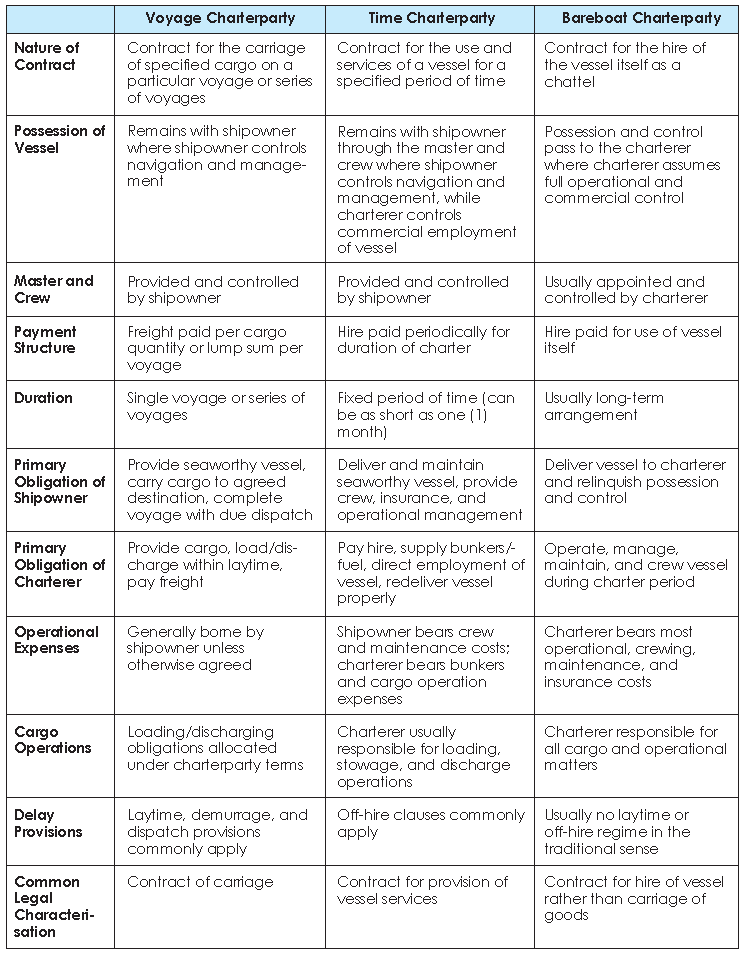
Comparing Voyage Charterparty, Time Charterparty, and Bareboat Charterparty5
Commercial Use of Chartered Vessel6
The purpose for which a vessel is chartered may include the carriage of goods, the carriage of passengers, salvage operations, towage services, or other specialised maritime activities. In certain circumstances, a charterer may further sub-charter the vessel to another party, in which case the charterer is commonly referred to as the disponent owner.
The contractual relationship governing the carriage of goods may arise either under the charterparty or the bill of lading, depending on the nature of the arrangement and the parties involved:
(a) Where the goods are shipped by the charterer himself and the bill of lading is issued in the charterer’s own name, the charterparty will generally constitute the principal contract of carriage, whilst the bill of lading operates primarily as a receipt and document of title;
(b) Where the goods are shipped by a third party, the contract of carriage is ordinarily evidenced by the bill of lading;
(c) In the context of a demise or bareboat charterparty, the contract of carriage under the bill of lading is typically between the shipper and the charterer; and
(d) In non-demise charterparties, the carrier is usually the shipowner, subject to the terms of the bill of lading and the surrounding circumstances of the particular case.
Conclusion
Charterparties form the contractual foundation of modern maritime commerce and play a critical role in facilitating international trade by sea. Whether structured as a voyage charterparty, time charterparty, or bareboat charterparty, each arrangement allocates rights, responsibilities, operational control, and commercial risks differently between the shipowner and the charterer. The choice of charterparty ultimately depends on the commercial objectives of the parties, the nature of the cargo operations, the level of operational control required, and the allocation of financial and legal risks.
Accordingly, a proper understanding of the legal and commercial characteristics of each type of charterparty is essential for parties operating within the shipping industry to effectively manage maritime operations, contractual obligations, and potential liabilities.
1. Halsbury’s Laws of Malaysia, vol 18(1), Carriers (LexisNexis Malaysia) para117.
2. Voyager Worldwide, ‘What Is a Voyage Charter?’ <https://www.voyagerportal.com/resources/voyage-charter/> accessed 24 May 2026.
3. Ibid.
4. Virtue Marine, ‘Time Charter vs Bareboat Charter: Key Differences Explained’ (Virtue Marine, 11 January 2024) <https://www.virtuemarine.nl/post/time-charter-vs-bareboat-charter-key-differences-explained> accessed 24 May 2026.
5. Halsbury’s Laws of Malaysia, vol 18(1), Carriers (LexisNexis Malaysia) para118 to 460.120.
6. Halsbury’s Laws of Malaysia, vol 18(1), Carriers (LexisNexis Malaysia) para 123.
Written by:
Philip Teoh (Partner) philip.teoh@azmilaw.com
Lim Teng Li (Associate) limtengli@azmilaw.com
Corporate Communications, Azmi & Associates – 12 August 2026
