



Outlining the Manufacturing Investment Process in Johor-Singapore Special Economic Zone (JS-SEZ)
Background: From Iskandar Malaysia to JS-SEZ
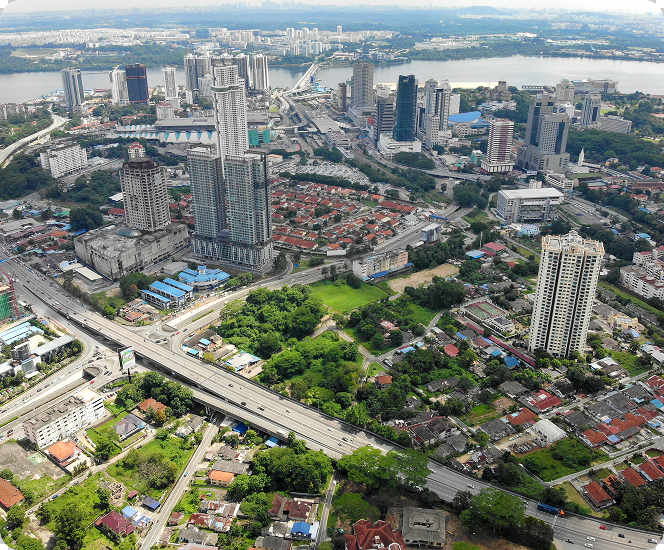
The development of Johor as a major investment destination began to accelerate with the establishment of Iskandar Malaysia in 2006, coordinated by the Iskandar Regional Development Authority (IRDA).1 As Malaysia’s first economic region, Iskandar Malaysia was established to drive economic growth in southern Johor by attracting domestic and foreign investment and developing key sectors including manufacturing, logistics, financial and business services, healthcare, education and tourism.2
Before the establishment of the JS-SEZ, Iskandar Malaysia was generally organised around 5 local authorities (PBTs):
1. Johor Bahru City Council (MBJB)
2. Iskandar Puteri City Council (MBIP)
3. Pasir Gudang City Council (MBPG)
4. Kulai Municipal Council (MPKu)
5. Pontian District Council (MDP)
Iskandar Malaysia successfully attracted substantial investment and established major industrial and economic hubs in southern Johor. Nevertheless, its broad development model faced challenges such as property oversupply and limited formal mechanisms for cross-border economic integration with Singapore. To address these gaps, Malaysia’s former Economy Minister Rafizi Ramli proposed the JS-SEZ in 2024 to offer investors a combination of Singapore’s sophistication and Johor’s cost and resource advantages, aiming to attract agile, high-tech investments with minimal bureaucracy.3 The subsequent establishment of the JS-SEZ in early 2025 builds upon Iskandar Malaysia’s existing strengths while introducing a more targeted framework for deepening Malaysia-Singapore economic cooperation and attracting high-value investment.
Introduction
Established in January 2025 via a binding bilateral agreement, the Johor-Singapore Special Economic Zone (JS-SEZ) ensures long-term policy certainty. Its strategic “twinning” model enables multinationals to base high-value headquarters in Singapore and cost-effective manufacturing in Johor. This synergy supports “China Plus One” strategies, building resilient supply chains for advanced electronics, digital infrastructure, and green energy. Ultimately, this roadmap outlines the essential legal and regulatory procedures for foreign manufacturers establishing operations within the zone.
Preliminaries
Identifying the Right Zone
Now under the JS-SEZ, the scope covers 3,588 square kilometres across nine distinct flagship zones.4 Each designed around specific industries and economic activities. Investors should select their location based on their industry, supply-chain requirements and available infrastructure.5 For example, technology companies and data centres may consider Kulai-Sedenak (Flagship F), while heavy manufacturing and petrochemical businesses may be better suited to Tanjung Langsat (Flagship D) or Pengerang (Flagship H). Financial and business services are considered in Forest City (Flagship I).6
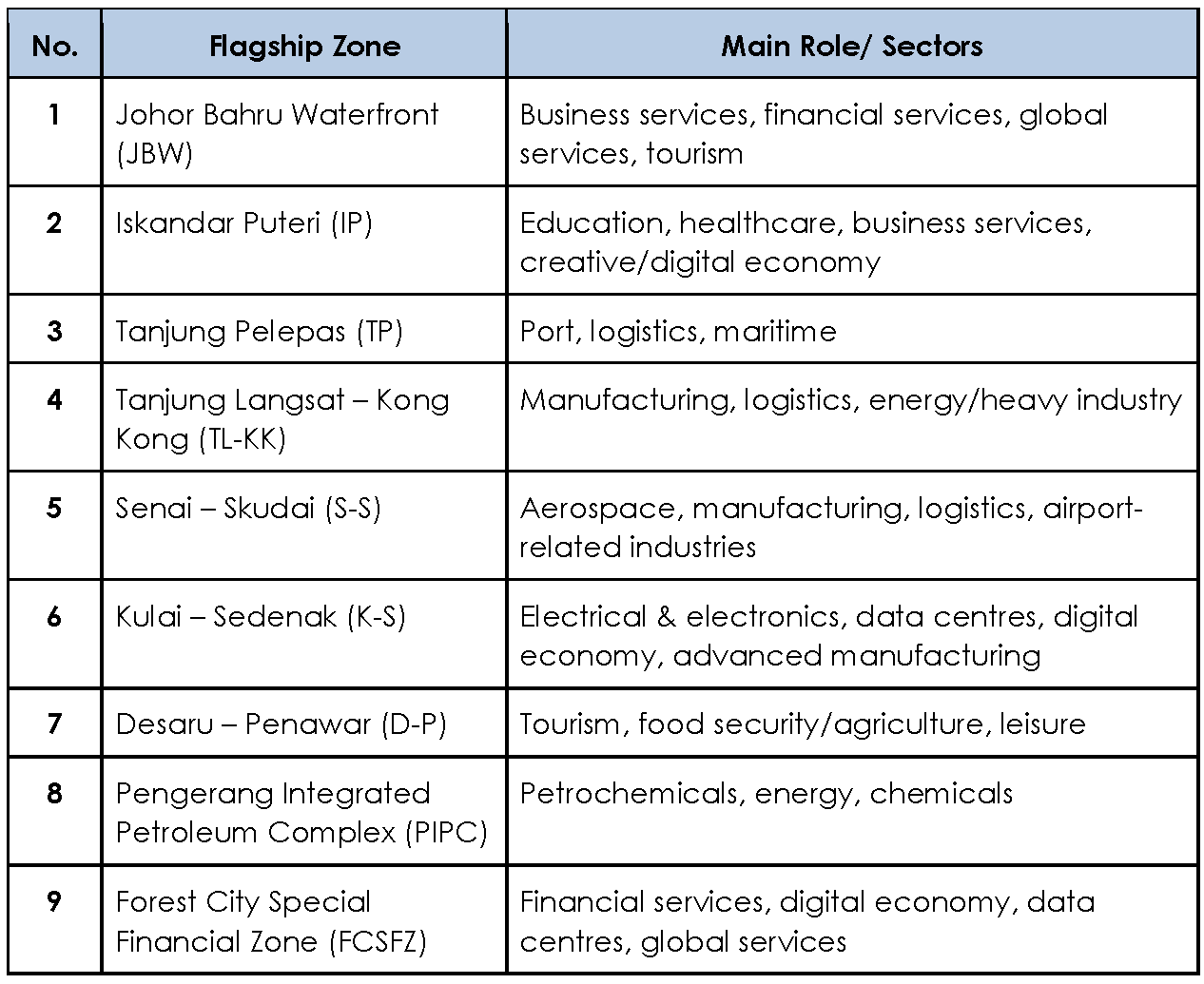
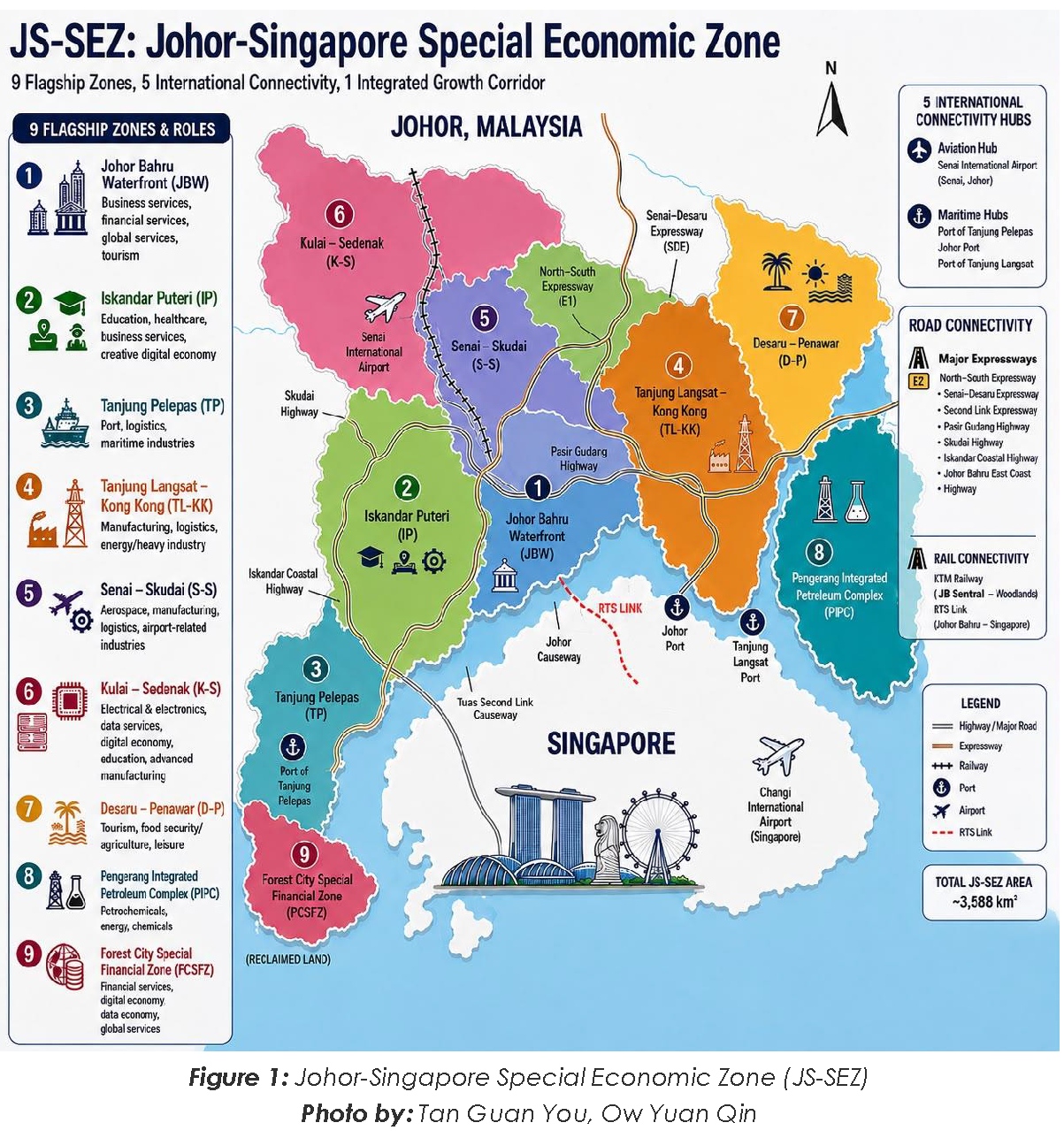
This zone integrates Johor and Singapore through robust physical, digital, and financial networks. Cross-border transit relies on the Johor Causeway, Tuas Second Link, and the upcoming RTS Link. Global trade is supported by an aviation network linking Senai and Changi airports, alongside a Tri-Port Maritime Gateway comprising the Tanjung Pelepas, Johor, and Tanjung Langsat ports. Streamlined by dedicated freight corridors and QR-based cargo clearance, the region is further united by a high-speed data backbone, energy pipelines, and seamless capital links enabling financial twinning with Singapore. For instance, the primary flagship zone for shipping, port logistics, and maritime services is suggested to be located in Flagship C: Tanjung Pelepas–Tanjung Bin as the Port of Tanjung Pelepas serves as the anchor maritime and smart logistics hub specializing in high-efficiency container terminal operations and global shipping connectivity.
Why Invest in JS-SEZ?
The JS-SEZ provides a range of tax, talent and connectivity incentives designed to reduce operating costs and facilitate cross-border investment. Qualifying investments in designated manufacturing and services activities may benefit from a special corporate tax rate of 5% for up to 15 years or a 100% Investment Tax Allowance (ITA), depending on the nature and scale of the investment. Eligible knowledge workers may also enjoy a preferential 15% personal income tax rate for up to 10 years, offering a substantial reduction from Malaysia’s standard progressive rates that peak at 30%, helping businesses attract and retain specialised talent.
The JS-SEZ also enhances cross-border mobility and talent relocation. QR-based immigration clearance facilitates faster movement between Johor and Singapore, supporting businesses that rely on frequent cross-border travel. For investors and their families seeking longer-term relocation, the MM2H Special Economic Zone (SEZ) category provides a 10-year renewable pass, subject to specified financial and property requirements. Alternatively, the Premium Visa Programme (PVIP) offers eligible investors and professionals residency of up to 20 years without a minimum stay requirement, allowing them to work and conduct lawful business activities in Malaysia. Together, these measures make the JS-SEZ more attractive for investors seeking lower operating costs, access to skilled talent and efficient connectivity.
Legal Entity Incorporation
For foreign investors looking to establish a business in the JS-SEZ, there are three main options in Malaysia: incorporate a local company, register a foreign branch, or set up a representative office. This flexibility allows investors to choose a structure that best matches their investment scale, business objectives and expansion plans.
I. The first is to set up a local Private Limited Company (Sdn. Bhd.), which creates a local legal entity that can own assets, hire employees and conduct business in Malaysia.7 This is suitable for investors planning a long-term or substantial investment.
II. Investors may also register their existing foreign company branch in Malaysia, allowing them to operate in the JS-SEZ while retaining their existing corporate structure.8
III. For investors who are not yet ready to commit to full-scale operations, a representative office provides a lower-commitment way to explore the JS-SEZ, conduct market research and develop local business connections. However, it is generally not permitted to conduct normal commercial activities or generate revenue in Malaysia.
For the financial sector, foreign banks intending to establish operations within the JS-SEZ require relevant licensing and regulatory approval from Bank Negara Malaysia (BNM) under the Financial Services Act 2013, and established a locally incorporated corporate entity.9 For example, HSBC Bank Malaysia Berhad is a locally incorporated Malaysian banking entity.
For the manufacturing sector, the typical route is to establish a Malaysian-incorporated company through the Companies Commission Malaysia (SSM), which can generally be 100% foreign-owned for new manufacturing projects. For example, foreign manufacturers operating in JS-SEZ commonly establish Malaysian-incorporated subsidiaries to carry out their manufacturing activities.
Foreign Equity Guidelines
Malaysia generally permits 100% ownership, however the applicable limit depends on the specific business activity and its regulator. Example of the sector-specific regulation includes:
1. Manufacturing: Foreign investors may generally hold 100% equity in new or expanding projects. However, under the Industrial Coordination Act 1975, projects with equity capital exceeding RM2.5 million or over 75 full-time employees must apply for a Manufacturing Licence from the Malaysian Investment Development Authority (MIDA).10
2. Private Higher Education/ Technical and Vocational Education and Training (TVET): 100% foreign equity. MIDA expressly permits 100% foreign equity in qualifying colleges, universities and TVET institutions.11
3. International Integrated Logistics Services (IILS): Qualifying companies may be 100% foreign-owned.12
4. Tour Operating and Travel Agency Businesses: An inbound-only licence may permit 100% foreign ownership; for inbound-and-ticketing businesses, the limit is 70% for Singaporean/Cambodian investors, 51% for other ASEAN investors and 30% for non-ASEAN investors.13
5. Hospitality (Hotel & Tourism): Generally 4 and 5 star hotels have no equity restriction, while 1 to 3 star hotels require a certain amount of Malaysian ownership. Both convention centres and theme parks have no equity restriction. Other tourism projects may require up to 49% of Malaysian ownership.14
In short, the Johor-Singapore Special Economic Zone permits 100% foreign equity across most commercial activities without a universal ownership cap. Bumiputera equity is legally mandated exclusively in strategic sectors such as logistics, upstream oil and gas, commercial banking, and telecommunications. Additionally, mandatory local joint ventures apply solely to domestic consumer services and small-scale retail.15 Consequently, investors should verify their specific industry guidelines and finalize their corporate structure prior to incorporation.
Land Acquisition and Conversion
Foreign State Consent
Under Section 433B(1) of the National Land Code, foreign entities must obtain Johor State Authority consent before acquiring any real estate. As affirmed in Jalaludeen A/L Abdul Aziz v Thrumalingam A/L S Rajadurai & Anor,16 the law strictly restricts property transactions involving non-citizens and requires this mandatory approval. Johor’s land office manages these applications, which apply to all purchases and long-term leases and typically take three to six months to process.
Land Use and Conversion
Repurposing agricultural land for commercial or industrial use requires a mandatory conversion process that typically takes 6 to 18 months. Operating without this approval is legally fatal. In Singma Sawmill Co Sdn Bhd v Asian Holdings (Industrialised Buildings) Sdn Bhd17, the Federal Court ruled that utilizing agricultural land for industry without conversion voids related commercial agreements for illegal consideration. Consequently, official land searches (carian rasmi) are vital due diligence to verify titles, uncover encumbrances, and prevent the inadvertent acquisition of strictly restricted Malay Reserve Land.
Leasehold vs. Freehold
Investors must carefully weigh freehold against leasehold titles. Freehold provides indefinite ownership but requires foreign buyers to get state’s consent . While 99-year leaseholds offer lower upfront costs and faster infrastructure access in managed parks, they require mandatory transfer consents, face strict financing hurdles under 60 years, and carry tenure limit risks.18 An example of this in the zone is AME Development’s premium freehold industrial properties at i-Park @ Senai Airport City, contrasted with Johor Corporation’s leasehold industrial plots under fixed 30-year or 60-year lease terms at the Tanjung Langsat Industrial Complex.19
Development Procedures and Planning Approvals
Planning Permission
Under the Town and Country Planning Act 1976, securing planning permission (Kebenaran Merancang) from decentralized local councils like MBJB, MBIP, or MBPG is a mandatory prerequisite for physical construction. Previously taking up to 37 months, the IMFC-J’s “Super Lane” protocol now compresses this timeline to 13 months by enabling the simultaneous submission of the core planning permission alongside engineering, street lighting, and landscaping plans.
Building Plans and CCC
Following construction, legal occupation mandates a Certificate of Completion and Compliance (CCC), certified by a Principal Submitting Person (PSP) who assumes statutory liability for the project. To prevent delays, state authorities begin site monitoring two months before expected completion. Once the PSP submits the CCC, councils issue business operation licenses within one hour, and companies are even permitted to install machinery prior to receiving the final certificate.20
Environmental and Utility Considerations
Under the Environmental Quality Act 1974, heavy or chemically intensive industries must submit an Environmental Impact Assessment (EIA) prepared by registered professionals to the Department of Environment (DOE) before construction. Massive projects require a detailed EIA, whereas standard industries need a Preliminary EIA, which is typically approved within five weeks.21
Licensing Applications and Sector-Specific Applications
Fast-Tracked Manufacturing Approvals
Coordinated by MIDA, Malaysia offers a seven-working-day fast-track manufacturing license for non-sensitive JS-SEZ projects, excluding strategic fields like defense. This framework guarantees a concurrent No Objection Letter from the Johor government and automatically grants the project “super-lane” priority handling across state and federal agencies, significantly benefiting conventional industries such as electronics and medical devices.22
Business Premise & Signboard Licenses
Federal approvals do not exempt businesses from securing mandatory municipal permits before starting daily physical operations. The state of Johor is divided into 16 local councils, and the specific council governing the site has final jurisdiction over localized operational permits. At a minimum, businesses require a composite premise and signboard license to occupy their site.
Conclusion
Despite the JS-SEZ’s fast-track licensing via the IMFC-J, successful market entry requires integrated legal planning. Investors must navigate federal, state, and local frameworks to prevent costly delays in land, tax, and municipal approvals. Furthermore, proactive corporate structuring is vital to secure tax incentives, manage transfer pricing, and avoid permanent establishment risks.
1. Malaysian Investment Development Authority, ‘Iskandar Malaysia: A Strong and Sustainable Metropolis of International Standing’ (MIDA, 1 October 2024) https://www.mida.gov.my/iskandar-malaysia-a-strong-and-sustainable-metropolis-of-international-standing/ accessed 13 August 2026.
2. ‘Economic Corridors – Iskandar Malaysia’ (MIDA, 1 October 2024) https://www.mida.gov.my/economic-corridors-iskandar-malaysia/ accessed 13 August 2026.
3. Aqil Haziq Mahmud, ‘Singapore’s sophistication, Johor’s cheaper cost create ‘best of both worlds’ for SEZ between both sides: Rafizi’ Channel News Asia (10 July 2024) https://www.channelnewsasia.com/asia/malaysia-johor-singapore-sez-rafizi-ramli-high-tech-investments-4469351 accessed 13 August 2026.
4. ‘About JS-SEZ’ https://www.js-sez.com.my/ accessed 13 August 2026.
5. Malaysian Investment Development Authority, ‘Key challenges to Johor-Singapore SEZ’ (MIDA, 27 February 2025) https://www.mida.gov.my/mida-news/key-challenges-to-johor-singapore-sez/ accessed 13 August 2026.
6. Malaysian Investment Development Authority, ‘Iskandar Malaysia: The Cornerstone of The Johor-Singapore Special Economic Zone’ (MIDA, 5 March 2025) https://www.mida.gov.my/iskandar-malaysia-the-cornerstone-of-the-johor-singapore-special-economic-zone/ accessed 10 August 2026.
7. Company Act 2016, s 14.
8. Company Act 2016, s 562.
9. Financial Services Act 2013, s 8, 10.
10.Malaysian Investment Development Authority (MIDA), ‘Equity Policy’ https://www.mida.gov.my/setting-up-content/equity-policy-protect-foreign-investment/ accessed 11 August 2026.
11. Malaysian Investment Development Authority (MIDA), ‘Education Services’ https://www.mida.gov.my/industries/services/education-services/ accessed 11 August 2026.
12. Malaysian Investment Development Authority (MIDA), ‘Logistics Services’ https://www.mida.gov.my/industries/services/logistic-services/ accessed 11 August 2026.
13. Malaysian Investment Development Authority (MIDA), ‘Tourism and Travel Related Services’ https://www.mida.gov.my/wp-content/uploads/2023/11/Booklet-9-Tourism-Travel-2021.pdf (MIDA 2021) accessed 11 August 2026.
14. Malaysian Investment Development Authority (MIDA), ‘Hospitality (Hotel & Tourism)’ https://www.mida.gov.my/industries/services/hospitality-hotels-and-tourism/ accessed 11 August 2026.
15. Quinn Lu, ‘Sector Insights – Malaysia Guide | Doing Business in Malaysia’ (ASEAN Briefing) https://www.aseanbriefing.com/doing-business-guide/malaysia/sector-insights/sector-insights-malaysia accessed 13 August 2026.
16. [2002] 1 MLJ 237.
17. [1980] 1 MLJ 21.
18. Malaysian Investment Development Authority, ‘Iskandar Malaysia: The Cornerstone of The Johor-Singapore Special Economic Zone’ (MIDA, 5 March 2025) https://www.mida.gov.my/iskandar-malaysia-the-cornerstone-of-the-johor-singapore-special-economic-zone/ accessed 10 August 2026.
19. KTL Global Limited, Lease Agreement in Respect of Land at Tanjung Langsat Industrial Complex (Company Announcement, 3 September 2014) https://www.sgx.com/ accessed 11 August 2026; AME REIT, ‘AME REIT to buy three freehold industrial plots in Johor-Singapore SEZ’ (AME REIT, 23 July 2026) https://amereit.com.my/ame-reit-to-buy-three-freehold-industrial-plots/ accessed 11 August 2026.
20. Street, Drainage and Building Act 1974 (Malaysia, Act 133), s 70.
21. Environmental Quality Act 1974 (Malaysia), s 34A; Department of Environment (Malaysia), Environmental Impact Assessment (EIA) Procedure and Requirements in Malaysia (DOE 2013).
22. Singapore Economic Development Board, ‘Malaysia sweetens JS-SEZ package with fast-track manufacturing licence approval, multiple-entry visa’ (EDB Singapore, 14 October 2025) https://www.edb.gov.sg/en/business-insights/insights/malaysia-sweetens-js-sez-package-with-fast-track-manufacturing-licence-approval-multiple-entry-visa.html accessed 10 August 2026.
Written by:
Mohd Zam Mustaman (Partner) zam.mustaman@azmilaw.com
Tan Guan You & Ow Yuan Qin editorial@azmilaw.com
Corporate Communications, Azmi & Associates – 14 August 2026