




Font Copyright Infringement in Malaysia: What to Do If You Receive a Demand Letter
Got a Demand Letter Over a Font? Don’t Panic Just Yet.
Proper corporate branding requires a solid foundation, and part of that is ensuring your creative assets and typography are properly licensed. But what happens when, despite your best efforts, you are targeted by an automated enforcement campaign?
It usually arrives without warning: a letter from a law firm, representing a major font licensing company, claiming the typography on your company website infringes their copyright. It demands a hefty sum and gives you 14 days to respond. For most business owners, the immediate reaction is panic, closely followed by the instinct to pay and make it go away. Before you write that cheque, it is worth examining the legal reality. Font copyright is far more complicated, and often far more favourable to the recipient of the demand letter, than these aggressive claims suggest.
The Core Distinction: Typeface vs. Font Software
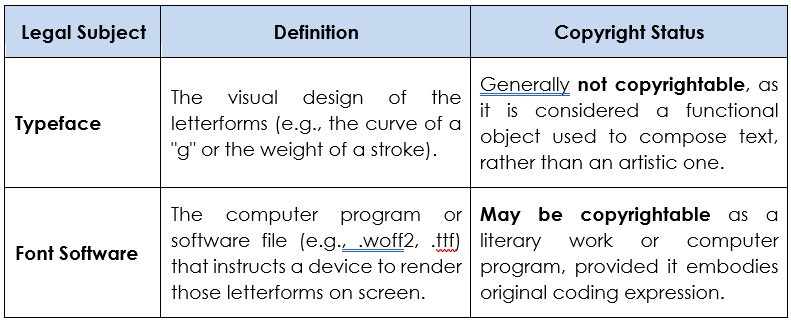
The most important distinction in this area of law is one most business do not appreciate until they are forced to confront it. These two elements are legally distinct, and that distinction matters enormously in litigation.
The Visual Design is Generally Not Copyrightable
This is perhaps the most surprising fact in font law: the actual shape of the letters cannot be protected by copyright in most jurisdictions. In the United States, this has been black letter law since Eltra Corp. v. Ringer (1978), where the court held that typeface designs are not eligible for copyright protection. This principle was even applied directly against major foundries in cases like Monotype Imaging, Inc. v Bitstream, Inc. (2005), where both parties expressly agreed that the visual design of a typeface is not copyrightable.
In Malaysia, Section 3 of the Copyright Act 1987 (CA 1987) defines “artistic work” through specific categories such as graphic works, photographs, and sculptures. There is no judicial authority that has affirmatively held typeface design to fall within any of these definitions. Unlike the United Kingdom, which explicitly extends copyright to typefaces through Sections 54 and 55 of their Copyright, Designs and Patents Act 1988, the Malaysian legal framework does not contain an in pari materia (equivalent) provision. Claimants cannot simply import UK principles into a Malaysian claim by mere assertion.
Fundamentally, copyright protects expression, not ideas. The visual style of a typeface, such as a font’s clean geometry, even stroke weights, and sans-serif uniformity, is merely a design concept or a typographic philosophy. It is an idea, and ideas remain outside the protective reach of the CA 1987.
Protecting the Software Code: The Burden of Proof
The font software file is a different matter. To the extent it embodies original coding expression, it may qualify for copyright protection. However, asserting this right and proving infringement are two entirely different hurdles. Before any question of infringement arises, Section 7(3) of the CA 1987 requires that sufficient effort must have been expended to make the work original. The Malaysian courts, through YKL Engineering v Sungei Kahang Palm Oil [2022] and Wedding Galore Sdn Bhd v Rasidah Ahmad [2016], confirmed that a claimant must affirmatively demonstrate that specific human skill, time, and labour were invested in creating the particular work claimed.
Furthermore, to establish copyright infringement by reproduction, a plaintiff must prove objective similarity, a causal connection, and that a substantial part of the copyrighted work was reproduced without authorisation, as consistently applied in Megnaway Enterprise Sdn Bhd v Soon Lian Hock [2009] and Honda Giken Kogyo Kabushiki Kaisha v MForce Bike Holdings Sdn Bhd [2019].
The Enforcement Reality: Assertion is Not Proof
Many large licensing companies maintain aggressive enforcement programmes driven by automated scanning tools that crawl the web matching metadata. When a match is found, demand letters are issued. However, attaching a collection of browser developer tool screenshots showing a .woff2 filename on a server is not a substantial similarity analysis.
As established in Computer Associates International v Altai Inc (1992) and guided locally by Longman Malaysia v Pustaka Delta Pelajaran [1987], the correct legal test for computer programs requires filtering out non-protectable elements and directly comparing the remaining protectable coding expression. A screenshot merely shows that a file was present on a server; it does not prove that the specific code of the font file was reproduced.
If your business receives such a demand letter, the most critical step is not to panic and not to pay immediately. These letters are commercial pressure mechanisms. You must put the claimant to strict legal proof. Engaging a legal team that understands the tactical nuances of IP litigation often reveal that your actual exposure is a fraction of the headline figure, if any exposure exists at all.
Disclaimer: This post is for informational purposes and does not constitute legal advice. If you are facing an intellectual property claim or an aggressive demand letter, reach out to our General & Intellectual Property Litigation Practice Group so we can assess the realities of your situation.
Written by:
Ahmad Hafiz Zubir (Partner) hafiz.zubir@azmilaw.com
Iman Danial Hakim Md Azam (Managing Associate) imandanialhakim@azmilaw.com
Corporate Communications, Azmi & Associates – 6 August 2026
